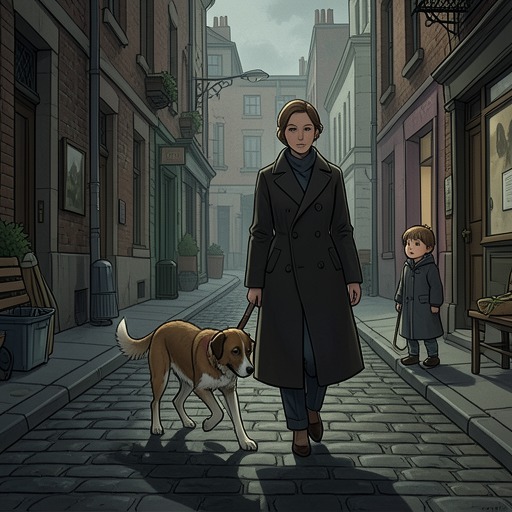
Domestic dogs
También esto pasaráDomestic dogs occupy a lasting place in the novel’s picture of family, memory, and loss. They are not simply pets arranged around human life: they have their own habits and attachments, and their presence reveals who cares for whom. Patum, the dog shared by Blanca, Guillem, and Blanca’s mother, carries the history of a changing family into the mother’s funeral and its aftermath. Other dogs, from a rescued household companion to the dogs Blanca encounters at Villa Beagle, broaden that history into a recurring attention to animal life and mutual recognition.
Household Companions and the Mother’s Court
Blanca’s mother gathers dogs into a lively household that can contain as many as five at once: three shared family dogs, the dog belonging to the woman who helped at home, whom Blanca’s mother had rescued, and sometimes a guest’s dog. She used to carry a leash in her bag in case she came across a lost dog. This readiness to take in animals makes rescue part of her everyday practice, not an isolated gesture. The dogs also form a social world of their own, a parallel court to the mother’s circle of friends.
That court comes with rules. Guests who complain about the dogs’ intrusions, or admit to being afraid of them, risk being dismissed as foolish and not invited again. A skilled poker player might earn an exception. The mother even prepares a clean towel for one formally dressed guest to put over her lap, shielding her from the dogs’ rubbing, licking, and uncertain hygiene. The scene is both comic and revealing: the dogs are welcome on their own terms, while human visitors are expected to accommodate them.
The mother’s attachment to dogs is especially vivid in her care for a litter born at home. Nana gives birth to what Blanca recalls as nine puppies; one dies within hours, while the others survive. The mother has a large wooden box made beside her bed and spends weeks watching over the litter. In a refined bedroom with raspberry-colored carpet, mirrors, mahogany furniture, and paintings of voluptuous women, she accepts the pervasive smell of a kennel and makes sure the stronger puppies leave food for the weaker ones and that Nana can rest. Blanca remembers her own alarm at the birth alongside her mother’s enthusiasm, and comes to recognize in this care the child her mother once was. Her love for that remembered girl becomes part of how she understands her mother.
Patum Between Blanca, Guillem, and Her Mother
Patum’s place in the family shifts without breaking the bond among its members. She had been Blanca and Guillem’s dog before Blanca left her with him during a trip. When Blanca returned, Guillem said Patum would stay with him and would be better off with his mother and sister. He kept her, and the narrator presents that decision as an instance of Guillem making his own what he loves. His attachment does not erase Patum’s earlier connection to Blanca or to Blanca’s mother; it adds another home and another caretaker to her history.
The dog also becomes a measure of the mother’s declining strength. Patum survives the mother and her sister, and the day the mother accepts, without protest, that the family must take Patum because she can no longer keep her, Blanca recognizes the concession as a sign that the end is near. For Blanca, surrendering the dog means more than changing a practical arrangement: it suggests that her mother is beginning to let go of everything. That afternoon, Blanca starts arranging for her mother to be buried at the Port Lligat cemetery.
Patum attends the funeral with Guillem. He gives her a black ribbon for her collar, and she sits formally in the shade beside him, unlike her usual sprawled posture. The narrator imagines that her mother would have liked the sight and pictures her sitting beside them with a hand on Patum’s head. This imagined presence makes the dog a link between the dead woman and the people who remain. Patum cannot be buried in the mother’s niche: Blanca explains that the dog is too large and that burying her there would be illegal. The decision keeps the funeral grounded in physical and legal limits, even as Patum’s presence gives it an intimate family significance.
Dogs as a Measure of Recognition
Dogs appear elsewhere as creatures whose freedom and attention can alter the emotional texture of a scene. On the way to Cadaqués, Blanca’s party stops at Villa Beagle, the home of Tom, who keeps rescued dogs and breeds Beagles. A dusty sign with green jumping dogs marks the entrance. When no one answers the bell, the children call out; barking rises in the distance, and a pack of dogs of different ages, breeds, and conditions gathers at the fence. Once the gate opens, the children run through the field with them, laughing and shouting.
Blanca responds to the dogs’ unrestrained running as a pleasure in being alive: ears streaming, tongues out, tails moving, with no need to ask why life is a gift. The dogs are domesticated animals, accustomed to confinement in flats, but here they have room to run, and their movement matters in itself. One old, scruffy dog, vaguely like a German shepherd, does not join the commotion. He stays beside Blanca, approaches when he sees her looking at him, and nudges her leg whenever she withdraws her hand from his head. When she asks his name, one of Tom’s young companions tells her it is Rey. Their connection begins without explanation or negotiation. Blanca thinks of such recognition as something that sometimes happens between two people, but in a dog it can last a lifetime.
Bereavement and the Dogs Who Remain
After the mother’s death, Patum’s behavior gives absence a physical form. She will not enter the mother’s room. Instead, she waits at the doorway and sniffs through the house for the mother’s scent or a sign that she will return. Blanca does much the same in her own way: she considers repeating trips they took together—to Athens, Venice, and New York—in the hope of finding her mother there. The parallel does not make Patum a symbol alone; the dog has her own searching routine, expressed through waiting and smell, while Blanca confronts grief through memory and imagined travel.
Patum, too, is nearing the end of her life. Guillem has told Blanca that the veterinarian doubts she will live through the winter. She is the last surviving member of the litter born in the house, once distributed among the mother’s friends. Blanca fears losing her and feels that this part of the world is growing emptier; she also thinks of Rey, who has lost his owner. Patum’s love for Blanca is described as irrational and disproportionate, perhaps the only kind of love worth having because it is undeserved. Yet the question of belonging remains unsettled: Patum is now Guillem’s dog, perhaps always was, since he gave her her name. Naming becomes a possible claim, but it does not undo the dog’s many attachments or the care that has passed among people and animals.
Across these episodes, dogs connect chosen family, practical care, and mourning without reducing animal life to a human lesson. Patum has her own loyalties and habits; the puppies require attentive care; Rey actively seeks contact with Blanca. Their distinct actions repeatedly expose bonds that separation, illness, and death cannot simply cancel. The dogs make care visible in everyday gestures—carrying a leash, making room for a litter, offering a hand to be nudged—and make loss visible in the doorway where Patum still waits.